 ultimate-guide
Acupuncture for Fertility: Evidence, Support & Finding Care
Table of Contents
- What the Evidence Shows About Acupuncture for Fertility
- Acupuncture for IVF Support: How It Complements Assisted Reproduction
- How to Support Male Fertility with Chinese Medicine
- Acupuncture Session Frequency for Fertility: What to Expect
- Stress Reduction, Hormonal Balance & Reproductive Health
- Finding a Qualified Fertility Acupuncturist
- Frequently Asked Questions
Last Updated: September 21, 2026
What the Evidence Shows About Acupuncture for Fertility
The clinical evidence for acupuncture and fertility is mixed, but growing. A systematic review from the National Library of Medicine analysed 40 citations and found that acupuncture shows a potential benefit for women with infertility, though the number of treatments appears to be a significant variable in outcomes.
More specifically, research indicates meaningful differences in conception rates. One study found a 42.5% clinical pregnancy rate in women undergoing IVF with acupuncture support, compared to 26.25% in a control group, a substantial gap that has drawn fertility clinics to integrate the practice into their protocols. Some research suggests a potential 65% increase in conception rates when acupuncture is combined with assisted reproductive technology, though meta-analyses note conflicting results across studies.
The reason for this variability is important to understand. High-quality randomised controlled trials have shown acupuncture does not always affect fertility outcomes, which is why practitioners and researchers emphasise that acupuncture for fertility works best as a complement to medical treatment, not a replacement. Think of it as part of a broader fertility support strategy, one that addresses hormonal balance, stress reduction, and reproductive health alongside conventional approaches.
Acupuncture for IVF Support: How It Complements Assisted Reproduction
Acupuncture for IVF support operates on a different logic than standalone fertility treatment. Rather than trying to trigger conception alone, it aims to optimise the conditions under which IVF is more likely to succeed.
The mechanism centres on three areas: improving uterine blood flow, regulating the endocrine system, and calming the nervous system during a notoriously stressful process. Clinicians report that acupuncture points are selected to support follicle development before egg retrieval, stabilise the luteal phase after embryo transfer, and reduce the cortisol spikes that can interfere with implantation.
Timing matters significantly. Most fertility acupuncturists recommend beginning treatment 2-3 months before an IVF cycle to establish baseline hormonal balance. Sessions typically continue through the cycle itself, before egg retrieval, around the time of transfer, and into the early luteal phase. This sustained approach, rather than one-off sessions, appears to drive the better outcomes reported in clinical practice.
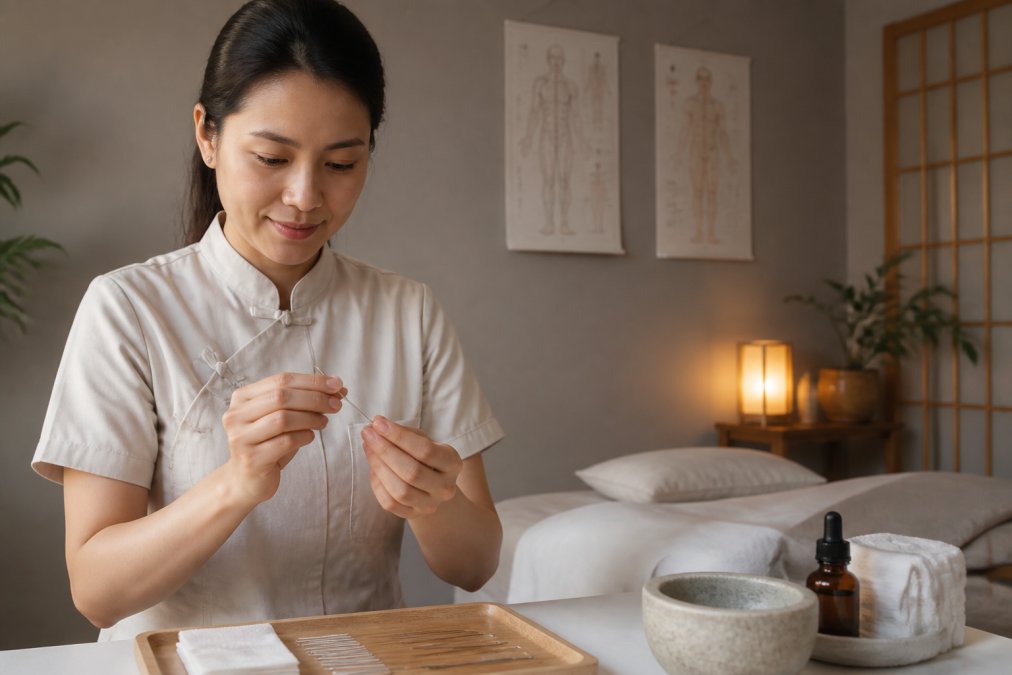
At LOEDA, we work with clients planning IVF by integrating acupuncture sessions into their medical timeline. This coordination with your fertility specialist ensures the treatments complement rather than conflict with your medical protocol.
How to Support Male Fertility with Chinese Medicine
Male factor infertility accounts for roughly 40% of conception difficulties, yet acupuncture and Chinese medicine for male fertility remains underutilised. The approach targets sperm quality, motility, and morphology through similar mechanisms used for female reproductive health.
Chinese medicine theory emphasises kidney yang and essence (jing) as foundational to sperm production. Acupuncture points are selected to support the endocrine system, improve blood flow to reproductive organs, and reduce oxidative stress, all factors that influence sperm parameters. Treatment protocols typically run 3-4 months to align with the full spermatogenesis cycle, which takes roughly 74 days.
The practical reality is that many couples pursuing fertility treatment focus entirely on the female partner's cycle. Including the male partner in acupuncture and Chinese medicine support can be a meaningful addition, particularly when sperm parameters are borderline or when conventional treatments have not yet succeeded. Some practitioners recommend concurrent treatment for both partners as part of a holistic pre-conception care strategy.
Acupuncture Session Frequency for Fertility: What to Expect
How often you attend acupuncture sessions directly influences outcomes. The research is clear on this point: frequency matters more than total duration. However, frequency is not uniform across your cycle, it shifts based on where you are in your menstrual or IVF timeline.
Menstrual Cycle-Based Treatment Protocol
For those pursuing natural conception, acupuncture protocols typically align with the four phases of the menstrual cycle, each requiring different point selection and frequency:
Menstruation phase (days 1-5): 1 session per week. Focus is on clearing stagnation and supporting the natural shedding process. Practitioners avoid points that strongly tonify during this phase.
Follicular phase (days 6-14): 1-2 sessions per week. As oestrogen rises and follicles develop, acupuncture shifts toward supporting follicle growth, improving ovarian blood flow, and promoting the rise of yang energy. This is when many practitioners introduce herbal support alongside needling.
Ovulation phase (days 14-16): 2 sessions per week, ideally timed around ovulation. Acupuncture aims to support the luteinising hormone surge and ensure smooth ovulation. Some practitioners recommend a session in the 24 hours before expected ovulation.
Luteal phase (days 17-28): 1-2 sessions per week. After ovulation, treatment shifts to supporting progesterone production, stabilising the uterine lining, and calming the nervous system. This phase is critical for implantation readiness if conception occurs.
A typical natural conception cycle spans 3-6 months of treatment, meaning 12-24 sessions total. This consistency allows the practitioner to track subtle shifts in basal body temperature, cervical mucus, cycle length, and energy patterns that inform ongoing point selection.
IVF-Integrated Treatment Protocol
When acupuncture is integrated with IVF, the timeline is more compressed but more intensive:
Pre-cycle phase (8-12 weeks before stimulation): 1-2 sessions per week. The goal is to establish hormonal baseline, reduce stress, and prepare the body for the demands of stimulation. Practitioners often recommend herbal support during this phase to support egg quality and uterine receptivity.
Stimulation phase (10-14 days): 1-2 sessions per week. Acupuncture supports follicle development and aims to improve response to gonadotropins. Some clinics coordinate timing so acupuncture sessions occur after ultrasound monitoring.
Egg retrieval window (3-5 days before and after retrieval): 2 sessions per week.
What to Expect During Your First Session
The acupuncturist will take a detailed history covering your menstrual cycle length, flow, symptoms, medical history, digestion, sleep quality, and emotional state. This comprehensive intake, standard in Chinese medicine, informs needle placement and point selection. They will likely ask about your fertility timeline, any previous treatments, and your current stress levels.
Stress Reduction, Hormonal Balance & Reproductive Health
Stress and fertility exist in a difficult feedback loop. High cortisol impairs the hypothalamic-pituitary-gonadal axis, the hormonal cascade that regulates ovulation and menstrual cycle regularity. Fertility anxiety itself becomes a physiological stressor, which is why stress reduction is not a luxury, it's a mechanism.
Finding a Qualified Fertility Acupuncturist
Not all acupuncturists have specialised training in fertility support. When searching for a practitioner, look for specific credentials, experience markers, and a clear understanding of treatment costs and expected investment.
Professional Credentials and Experience
A qualified fertility acupuncturist should hold formal acupuncture registration. In Australia, this typically means registration with the Chinese Medicine Board of Australia (CMBA) under AHPRA (Australian Health Practitioner Regulation Agency).
Understanding Treatment Costs and Investment
Fertility acupuncture is a financial commitment, and understanding the total cost structure upfront helps you plan and compare practitioners fairly.
Questions to Ask Before Committing
During your initial consultation (many practitioners offer a free 15-20 minute phone or in-person chat), ask:
- What is your specific training in fertility acupuncture, and how long have you been practising?
- How many fertility clients do you see, and what outcomes have you observed?
- Do you coordinate with fertility clinics or GPs? Can you provide references or examples?
- What is your recommended treatment frequency and expected timeline for my situation?
- What is the total estimated cost for a full treatment cycle, including any herbal medicine, and where can I find pricing information?
- If I pursue IVF, how will you adjust your protocol, and where can I find pricing information for IVF-integrated support?
- What happens if I don't conceive after the recommended cycle? Do you offer follow-up protocols or adjustments?
- How do you track progress, and how often do we reassess the treatment plan?
Red Flags
Avoid practitioners who:
- Claim acupuncture alone will resolve infertility without acknowledging the need for medical evaluation and possible assisted reproduction.
- Pressure you into lengthy prepaid packages (e.g., 50 sessions upfront) without a clear refund policy or flexibility.
- Cannot articulate how their approach integrates with your broader fertility plan or refuses to communicate with your medical team.
- Promise guaranteed conception rates or specific timelines (e.g., "You will conceive within 3 months").
- Recommend expensive herbal formulas or supplements without explaining the rationale or offering alternatives.
- Do not ask detailed questions about your cycle, medical history, or fertility goals during the initial intake.
The Relationship Matters
Fertility acupuncture is a partnership. Your practitioner should listen carefully, adapt treatment based on your cycle and response, and communicate transparently about costs, timelines, and realistic expectations. They should view acupuncture as one tool within your broader fertility strategy, not as a standalone solution. A qualified fertility acupuncturist will help you integrate Chinese medicine with medical treatment, supporting your wellbeing and reproductive health throughout your fertility journey.
Frequently Asked Questions
Does acupuncture actually work for fertility?
Research shows mixed but promising results. A 2024 study found a 42.5% clinical pregnancy rate in women undergoing IVF with acupuncture, compared to 26.25% in a control group. A meta-analysis shows conflicting findings across studies, some identify benefits for conception while others show no statistically significant impact. The evidence suggests acupuncture may offer value as a complementary therapy, particularly when integrated with assisted reproductive technology, though results vary by individual and treatment protocol.
How many acupuncture sessions do I need for fertility support?
The number of sessions is a significant variable in treatment outcomes. Most practitioners recommend starting with a course of 8-12 sessions to assess response, then adjusting based on your cycle and fertility goals. For IVF support, treatment typically begins 2-3 months before egg retrieval and continues through embryo transfer. Your practitioner will tailor frequency to your menstrual cycle phase and individual needs. Consistency matters more than a fixed number of sessions.
How does acupuncture support male fertility?
Chinese medicine approaches male fertility by improving blood flow to reproductive organs, reducing stress on the endocrine system, and supporting sperm quality. Acupuncture targets points that enhance circulation and hormonal balance, addressing factors like poor sperm motility or count. Treatment typically focuses on the luteal and follicular phases of your partner's cycle as well. A qualified practitioner will assess underlying imbalances and design a protocol tailored to sperm health and reproductive function.
What should I look for in a qualified fertility acupuncturist?
Seek a practitioner with formal training in Traditional Chinese Medicine (TCM), relevant credentials in your state or territory, and specific experience with fertility and IVF support. Ask about their approach to menstrual cycle regulation, embryo transfer preparation, and stress management. Verify they work with a patient-centred philosophy and can explain their treatment protocol clearly. A good practitioner will also ask detailed questions about your fertility journey and integrate acupuncture with lifestyle and dietary support for holistic care.