 ultimate-guide
Acupuncture for Stress and Anxiety Relief: A Guide
Table of Contents
- How Acupuncture for Stress and Anxiety Relief Works
- The Science and Research Behind Acupuncture
- What to Expect at an Acupuncture Appointment
- How Many Acupuncture Sessions for Anxiety and Stress Relief?
- Choosing an AHPRA Registered Acupuncturist
- Acupuncture vs Other Treatments for Stress and Anxiety
- Side Effects and Safety Considerations
- Frequently Asked Questions
Last Updated: September 13, 2026
How Acupuncture for Stress and Anxiety Relief Works
Acupuncture for stress and anxiety relief uses fine needles inserted at specific points to influence the nervous system and promote a calmer state. At LOEDA, we see it as part of a broader holistic strategy for emotional balance, not a standalone cure. (Source: a comprehensive review of randomised controlled trials)
The core mechanism is nervous system regulation. A needle at a chosen point triggers a bio-physiological response that shifts the body toward a parasympathetic, rest-and-digest state. Many people notice this first as heaviness, warmth, or slowing down during the session.
Nervous system regulation and the parasympathetic response
Stress keeps the body in a low-grade fight-or-flight loop. Acupuncture aims to interrupt that loop.
A common mistake is expecting one session to reset months of tension; the calming effect builds over a series of treatments. Needle insertion is usually a mild ache or tingle rather than sharp pain, and many people drift into a relaxed, almost sleepy state within minutes.
Cortisol levels, endorphin release and feel-good hormones
The stress response is driven largely by cortisol. Acupuncture is thought to support hormonal regulation, helping bring stress hormones toward a balanced baseline.
The treatment also appears to encourage endorphin release. These feel-good hormones are the body's natural pain and mood regulators, which may explain the lifted mood and reduced anxiety many report after a session.
The Science and Research Behind Acupuncture
The evidence base for acupuncture in stress and anxiety is real but uneven. Here is how the research breaks down, and where the gaps sit.
What the trials tend to show
Most randomised controlled trials of acupuncture for anxiety use self-report scales such as the State-Trait Anxiety Inventory (STAI) or the Hamilton Anxiety Rating Scale (HAM-A). Reviews commonly show a statistically significant reduction in anxiety scores favouring acupuncture over no treatment or waitlist control, with a smaller, less consistent advantage against sham (non-penetrating) needles. That sham comparison matters: part of the benefit may come from the ritual, the quiet room, and the expectation of relief, not only needle placement.
For stress, trials often measure physiological markers alongside questionnaires, salivary cortisol, heart rate variability (HRV), blood pressure, sometimes skin conductance. Results are mixed: some studies show a drop in salivary cortisol, others no cortisol change but improved HRV, reflecting a shift toward parasympathetic activity. A reasonable reading is that acupuncture may influence the stress response through autonomic regulation even when hormonal markers stay flat.
Mechanisms researchers actually propose
Several mechanisms are plausible and not mutually exclusive:
- Endogenous opioid release. Needling is thought to trigger the release of endorphins and enkephalins, the body's own pain- and mood-modulating chemicals. This is one of the better-studied pathways and is also why acupuncture is used in some pain settings.
- Autonomic nervous system modulation. Needling at certain points appears to influence vagal tone, shifting the balance from sympathetic (fight-or-flight) toward parasympathetic (rest-and-digest) activity. HRV is the usual proxy for this.
- Hypothalamic-pituitary-adrenal (HPA) axis effects. The HPA axis governs cortisol production. Some research suggests acupuncture may dampen an overactive HPA response, though findings are inconsistent and study designs vary widely.
- Local connective tissue and nerve signalling. Modern imaging work suggests needle rotation can cause mechanical signalling through fascia and connective tissue, which may feed back into the central nervous system.
- Expectancy and the therapeutic encounter. This is not a dismissal. The context of treatment, a calm environment, a practitioner's attention, the belief that something is being done, measurably affects anxiety in its own right.
Where the evidence is weak
Be sceptical of any source presenting acupuncture as settled science for anxiety. Common limitations include small sample sizes, short follow-up (often only a few weeks), difficulty blinding participants, and heterogeneity in sessions and points used. Systematic reviews frequently call for larger, better-controlled trials, a fair criticism, not a reason to ignore the signal.
Australian research and regulatory context
Australian researchers have contributed to this field, particularly through university-based trials and reviews examining acupuncture for anxiety, depression, and chronic stress. If you want to read primary research, the most efficient route is a search of PubMed for peer-reviewed acupuncture and anxiety studies, filtering for systematic reviews and randomised controlled trials. For a plain-language overview of what acupuncture is and how it is regulated, the National Center for Complementary and Integrative Health overview of acupuncture is a useful starting point, though note it is a United States body and its regulatory comments do not describe the Australian system.
In Australia, the relevant regulator is the Australian Health Practitioner Regulation Agency (AHPRA), which registers acupuncturists under the Chinese Medicine Board of Australia. Registration requires approved qualifications, English language standards, and ongoing continuing professional development. That regulatory layer is what separates a registered practitioner from an unregistered one, and it is the single most useful quality signal when you are assessing a provider.
What to Expect at an Acupuncture Appointment
A first appointment runs longer than follow-ups because it includes a detailed health history before any needles are used, with questions about your sleep, digestion, stress levels, and medical background.
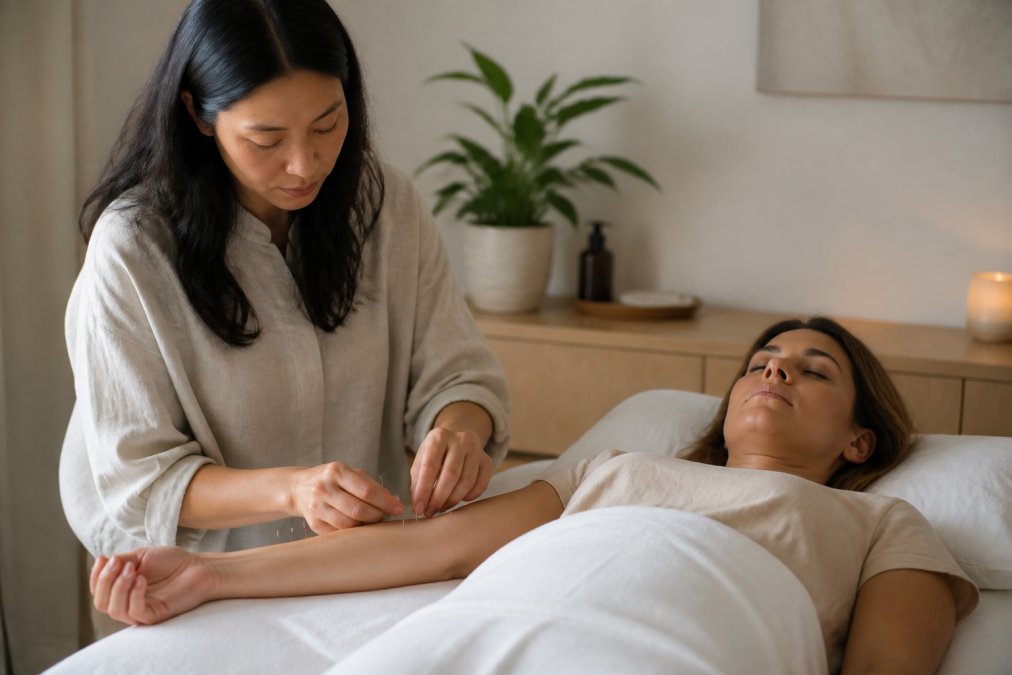
You will usually lie on a treatment table, fully clothed or with a gown, in a warm, quiet room. The practitioner feels your pulse and may look at your tongue, standard Chinese medicine assessment, then places fine needles at selected meridian points for around 20 to 30 minutes. Most people feel relaxed, and some fall asleep.
Afterwards, you may feel deeply relaxed or slightly tired. Plan a quiet evening if you can. Patient education matters here: ask what points were used and why, so you understand your own treatment.
How Many Acupuncture Sessions for Anxiety and Stress Relief?
There is no fixed number, but a common approach is a short initial course, often weekly for several weeks, then less frequent maintenance. Frequency depends on how long you have been stressed, how you respond, and whether you are also addressing sleep, diet, and workload. (Source: the physiological effects of acupuncture on the autonomic nervous system)
- Weeks 1 to 4: often weekly sessions to build momentum
- Weeks 5 to 8: spacing out to fortnightly if you are responding well
- Ongoing: monthly or as-needed sessions for maintenance
If you see no change at all after a handful of sessions, that is useful information. Discuss it openly with your practitioner rather than pushing on indefinitely.
Choosing an AHPRA Registered Acupuncturist
In Australia, acupuncture practitioners must be registered with the Australian Health Practitioner Regulation Agency (AHPRA). Choosing an AHPRA registered acupuncturist is the single most important safety step you can take.
You can verify any practitioner's registration through the AHPRA register of practitioners. Registration confirms the practitioner meets national standards for training and conduct. Beyond that, ask about their experience with anxiety and stress specifically, and how long a typical course of treatment runs.
At LOEDA, our practitioners combine acupuncture and Chinese medicine with a gentle, calming approach, and we are happy to explain our credentials and experience before you book.
Acupuncture vs Other Treatments for Stress and Anxiety
Acupuncture is one option among several, rarely the whole answer. The useful question is not 'which is best' but 'where does acupuncture fit for my situation, and what will it cost in time and money'.
How the main options compare
| Approach | Typical Focus | Best For | Time and Access | Notes |
|---|---|---|---|---|
| Acupuncture | Nervous system regulation, autonomic and hormonal balance | People wanting a low-risk, drug-free complement to other care | Weekly sessions for several weeks, then maintenance; private practice or some community clinics | Often used alongside other care |
| Talking therapy (CBT, ACT) | Thoughts, behaviours, coping skills | Persistent anxiety, panic, social anxiety, health anxiety | Weekly or fortnightly sessions with a psychologist; Medicare rebates available under a Mental Health Treatment Plan from a GP | Strong evidence base |
| Medication | Neurochemistry | Moderate to severe symptoms, or when therapy alone is not enough | GP or psychiatrist; PBS-subsidised for some medicines | Prescribed and monitored by a doctor |
| Exercise and sleep | Lifestyle foundations | Everyone, as a baseline | Free or low cost; self-directed | Supports every other treatment |
| Acupressure (self-applied) | Same points, no needles | Between sessions, or if needles are not for you | Free; a few minutes daily | Useful adjunct, not a replacement |
Matching the approach to the anxiety type
Generalised anxiety, panic attacks, and social anxiety respond differently to different inputs, and acupuncture does not suit all three equally.
- Generalised anxiety, the persistent, background worry pattern, is where acupuncture is most often used as a complement. The calming, autonomic-shifting effect fits the chronic low-grade arousal that characterises it.
- Panic attacks are acute events. Acupuncture is not a treatment for a panic attack in progress. It may help reduce baseline arousal over time, which can lower the frequency of attacks, but the acute management tools are breathing, grounding, and where prescribed, medication.
- Social anxiety is driven heavily by anticipatory thought patterns and avoidance. Talking therapy, particularly CBT with exposure work, is the first-line approach. Acupuncture can support the general stress load but does not address the cognitive core.
If you are unsure which category you fall into, that is a conversation for your GP or psychologist, not your acupuncturist.
What it actually costs, and how to make it affordable
Acupuncture is generally private-pay in Australia. Pricing is available on our website. Prices vary by practitioner experience and session length.
Ways to reduce the cost:
- Private health insurance. Many extras policies include acupuncture under their ancillary cover. Check your annual limit, whether a referral is required, and whether the provider must be AHPRA-registered (most funds require this).
- Community acupuncture clinics. These operate on a sliding scale or a lower fixed fee, often in a group setting with recliner chairs rather than private rooms. Sessions are shorter and the fee is typically a fraction of private practice rates. The trade-off is less individual consultation time.
- Medicare. Acupuncture is not generally covered by Medicare for anxiety or stress. Some chronic disease management plans may include a limited number of allied health sessions, but acupuncture is not a standard inclusion, so do not assume a rebate.
- Packages. Some clinics offer a discounted block of sessions. Ask before you book, and be wary of large upfront packages before you know whether the treatment suits you.
A practical way to decide
A reasonable sequence: see your GP first for a mental health assessment, and if a Mental Health Treatment Plan is appropriate, use it for psychology sessions. Add acupuncture as a complementary layer if you want a low-risk, drug-free input. Give it a defined trial, say six to eight sessions, and judge it on whether your sleep, baseline tension, and anxiety scores have shifted. If not, stop and redirect the money.
The honest position: acupuncture is a low-risk intervention many people find helpful for stress reduction and emotional balance, but it does not replace psychological or medical care where needed. Used as part of a broader plan, with realistic expectations and a defined trial period, it is a reasonable addition.
Side Effects and Safety Considerations
Acupuncture is generally well tolerated by a registered practitioner, but not risk-free. Common minor side effects include small bruises or bleeding at needle sites, mild soreness, and occasional light-headedness.
Serious complications are uncommon but possible, which is why sterile, single-use needles and proper training matter. Tell your practitioner if you are pregnant, take blood-thinning medication, or have a bleeding disorder. This is general information only and not individual medical advice; speak with a qualified professional about your own situation.
Frequently Asked Questions
How effective is acupuncture for stress and anxiety?
Research suggests acupuncture can reduce symptoms of stress and anxiety for some people. It may work by supporting nervous system regulation, lowering cortisol levels, and prompting endorphin release. Many people report feeling calmer after a session, though responses vary. Acupuncture is often used as a complementary therapy alongside other approaches, not as a replacement for medical or psychological care. Speak with a qualified practitioner to see if it suits your situation.
How many acupuncture sessions for anxiety are typically needed?
There is no fixed number. Some people notice a difference after one or two sessions, while others may need a course of six to eight treatments before assessing progress. Your practitioner will consider how long you have had symptoms, their severity, and how you respond. A common approach is weekly sessions initially, then spacing them out as things improve. Ask about a review point so you are not committing to months of treatment blindly.
What should I expect during my first acupuncture session for anxiety?
Your first appointment usually includes a detailed health history, a discussion of your stress and anxiety symptoms, and a gentle physical assessment. The practitioner then inserts fine needles at specific points. You may feel a mild pinch or dull ache. Needles typically stay in for 20 to 30 minutes while you rest. Many people find the experience deeply relaxing and may feel sleepy afterwards. Wear comfortable clothing and avoid scheduling anything demanding straight after.
Are there any side effects of acupuncture for anxiety?
Acupuncture is generally considered a low-risk intervention when performed by a qualified practitioner. Common side effects include minor bruising or bleeding at needle sites, mild soreness, or feeling lightheaded. Serious complications are rare. To reduce risk, choose an AHPRA registered acupuncturist who follows infection control standards. Tell your practitioner about any medications, bleeding disorders, or pregnancy before treatment so they can adapt their approach safely.
Stress and anxiety rarely resolve on their own, and finding the right support can feel overwhelming. At LOEDA, our practitioners offer acupuncture and Chinese medicine in a calm, restorative space designed to ease the nervous system and support your emotional balance. If you are ready to add a gentle, non-invasive option to your plan, get started with LOEDA and book a consultation to see how acupuncture for stress and anxiety relief could fit your routine.